Access to the Countryside in Shetland
- Introduction
- Part 1 of the Land reform Act (2003)
- Scottish Outdoor Access Code
- Rights of Way
- Access Forum
- Core Path Plan
- Shetland Ranger Service
- Current Initiatives
- Minutes of Access Forum Meetings
- Contact us for Details
Introduction
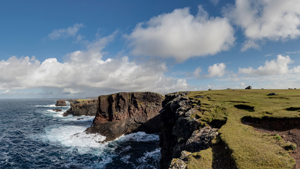
In Shetland there has always been a traditional freedom of access and the Planning Service are committed to maintaining this tradition by assisting both land users and managers to develop the fantastic outdoor environment that we have. Shetland has over 1000 miles of coastline with scenery that is on par with some of the most beautiful areas in the world. The islands also have a unique culture and heritage that cannot be ignored which adds to the magnificent outdoor environment. The islands also have many small crofts and farms so there is a continued need for the management of access and support for land managers and this is addressed in the Shetland Access Strategy. Shetland has many places to walk, cycle or horse ride, as long as you act responsibly.
Part 1 of the Land Reform Act (2003)
Part 1 of the Land reform (Scotland) Act 2003 was produced to make it easier for people to enjoy the outdoors and to be clear about what they can and cannot do. The Act provides a clearer legal basis for access and responsibility is the key principle for access rights and managing land and inland water. The Act safeguards land management, privacy and conservation. It also gives new duties and powers to the Council and other public bodies. A summary of the Land reform (Scotland) Act 2003 can be found here.
Scottish Outdoor Access Code
Shetland's outdoors include croft land, farmland and also the open hill which all provide great opportunities for open-air recreation and education. Part 1 of the Land Reform (Scotland) Act 2003 gives everyone statutory access rights to most land and inland water. People only have these rights if they exercise them responsibly. The Scottish Outdoor Access Code explains the responsibilities of the public and of land managers in enabling all to benefit from access without disrupting each other. The act sets out where and when access rights apply while the Scottish Outdoor Access Code defines how access rights should be exercised.
The Three key principles for responsible access apply to both the public and land managers:
- Respect the interests of other people: Be considerate, respect privacy and livelihoods, and the needs of those enjoying the outdoors.
- Care for the Environment: Look after the places you visit and enjoy. Care for wildlife and historic sites.
- Take Responsibility for your own actions: The outdoors cannot be made risk free for people exercising access rights;land managers should act with care for people's safety.
Local Access Forum
Section 25 of the Land Reform (Scotland) Act 2003 requires the Council to establish a Local Access Forum. The Forum is a way of bringing together all parties with an interest in developing and managing access. It is an advisory body helping to promote a cooperative approach to Access development and management. Shetland's Access Forum, which consists of 12 members representing a range of public bodies throughout Shetland will hold meetings at least 4 times a year to discuss a range of Access issues.
The objectives of the forum are:
- to act as the local Access Forum for Shetland and to undertake the functions of that body if and when statutorily required to be established by Shetland Islands Council.
- to advise Shetland ISlands Council on strategic access issues and the development of the Core Path Plan Network in Shetland through the policies and priorities of the Shetland Access Strategy.
- to promote the responsible access through the Scottish Outdoor Access Code
- to promote the sharing of knowledge, awareness, and good practices
- to offer Shetland Islands Council advice which will assist in resolving access problems.
The Forum Communication Plan sets out the basis for communication flows between the Forum, the Forum working groups and the general public.
The Forum Partnership Agreement can be sourced here
For Forum contact details and copies of minutes, agendas and reports please contact the planning implementation Officer (01595) 744832 or e-mail development.plans@sic.shetland.gov.uk

Core Paths Plan
Core Paths Plans were introduced by Part 1 of the Land Reform (Scotland) Act 2003. The purpose of the Plan is to designate a system of paths to provide the basic framework of routes (which are) sufficient for the purpose of giving the public reasonable access throughout their area (and which will) link into and support wider networks of other paths and routes. The Council has three years of the coming into force of Part 1 of the Act to develop the Core Path Plan for Shetland.
The core path will comprise of many different types of paths, ranging from natural ground to constructed paths. Taken as a whole, the core paths system will cater for all types of users - walkers, cyclists, horse riders, canoeists, people with disabilities, etc - but not all individual routes will need to be designated for every type of user. The core paths will be clearly shown on the Councils official core path maps.

This new statutory focus on making provision for non-motorised access to and in the outdoors has profound and wide-ranging ramifications. In addition to the obvious recreational aspects it is intended to: (i) support healthy lifestyles and health improvement initiatives; (ii) promote walking and cycling as sustainable transport modes for everyday trips to schools, shops, workplaces and leisure activities; (iii) contribute towards social inclusion and community safety, and (iv) promote economic development.
Over the Core Path Plan development period, the Council will be carrying out consultations with the public and various bodies to develop the path network. For more information please contact the Planning Service (see Contact Us for details).
Shetland Draft Core Paths Plan: Formal Consultation 7th July - 29th September 2008
Introduction: Core Paths Plan Explained
Shetland Draft Core Paths plan and maps:
- Shetland Draft Core Paths Plan text
- Map Key
- Bressay
- Burra and Trondra
- Delting
- Dunrossness
- Fair Isle
- Fetlar
- Gulberwick Cunningsburgh and Quarff
- Lerwick
- Nesting and Lunnasting
- Northmavine
- Sandsting & Aithsting
- Sandwick
- Scalloway
- Skerries
- Tingwall Whiteness and Weisdale
- Unst
- Walls & Sandness (Including Papa Stour & Foula)
- Whalsay
- Yell
- Core Paths with SNH designations
- Core Paths with scheduled monuments
- List & map of Asperational Routes
- Appendix
- Core Paths Still to Complete
- SEA Environmental Report for Shetland Draft Core Paths Plan
Shetland Ranger Service
Shetland has four Ranger Services who assist with monitoring and maintaining existing access routes and infrastructure provision throughout Shetland. They also provide and support the provision of interpretive information relating to the natural heritage, so as to enhance the quality of experience for tourists and Shetland residents alike. This includes guided walks (including the annual Walking Festival in August), open days, publications and other interpretive media. The Ranger Service, whose details are shown below can be the first point for contact for issues to do with Access.
South Shetland Ranger Service
Area Covered: Mainland (south of Laxo-Voe), Whalsay and the Out Skerries
Contact Details:
Shetland Amenity Trust
Garthspool
Lerwick
Shetland
ZE1 0NYTelephone: (01595)694 688
North Shetland Ranger Service
Area Covered: Mainland (North of Laxo-Voe) Fetlar, Yell and Unst
Contact Details:
Unst Heritage Centre
Haroldswick
Unst
Shetland
ZE2 9EFTelephone: (01957) 711 528
Foula Ranger Service
Contact Details:
Foula Heritage
Freyers
Foula
Shetland
ZE2 9PNTelephone: (01595) 753 233
Fair Isle Ranger Service
Contact Details:
Fair Isle Bird Observatory
Fair Isle
Shetland
ZE2 9JUTelephone: (01595) 760 258
Current Initiatives
Under the Corporate Improvement Plan and the Shetland Cultural Strategy, the Planning Service with help from the Shetland Ranger Service, Scottish Natural Heritage, National Health Service, Crofters Commission and Shetland Enterprise have been and will continue to assist crofters and community groups to improve Access provision throughout Shetland.
The common reasons for improving access are to boost local tourism and economic activity, contribute to the social network in the community, provide valuable recreational resource, improve peoples health and well-being and allow people to go from A to B sustainably.
The Planning Service recognises that there are areas of concern, both for the land manager and the person trying to access the outdoors, to visit a site of interest or walk along the coast, for example. These problems can range from the public being unsure about where they are allowed to go to the gates not working properly, to people climbing over fences and causing damage, disturbing livestock or plants or wild animals. Visitor management can help solve these problems and the Council would be interested to hear from any crofter, farmer or land manager where such problems exist. Alternatively if a member of the public has a particular issue with regards to countryside access such a route that is difficult to negotiate due to barbed wire fence, they should contact the local authority.
Assistance is available to help install stiles or self-closing gates, which would prevent damage to fences. Way-markers, information signs and warning signs can also be provided to ensure the public are directed away from the dangers and livestock and also notify visitors of farming operations such as lambing.
Over the past two years, numerous access improvement projects have been completed at the request of crofters, farmers and community groups. Access infrastructure for the disabled and elderly has been put in place and access to many lochs has been improved for anglers.
Under the Paths to Health initiative, the Council have been working along with NHS to develop Walk to Health leaflets for various communities. Any community groups who are interested in working along with the Council and the NHS to develop walks in their area should contact the Planning Service (see Contact Us for details).
Public Rights of Way
The Council are currently in the process of developing a Rights of Way database for Shetland. If you know of a route which you think may be a Public Right if Way of have a complaint about a route, please contact the Planning Service (see Contact Us for details). Eventually the recorded Rights of Way's will be transferred to the national database, the National Catalogue of Rights of Way (CROW)
For a route to be a Right of Way it must meet the following criteria:
-
It is a requirement that it runs from one public place to another public place. A public place can be defined as somewhere where the public are entitled to be - e.g. a public road, a village, a church, a harbour etc. Generally private farms, old castles, hotels etc would NOT be regarded as public places as visitors would be exercising private access rights only. The foreshore, or beach areas may not necessarily be public places.
-
The route should follow a more or less consistent and generally defined line, although minor deviations are not of significance to the establishment of a route as a right of way.
-
For the route to be a right of way it must have been used by the public without substantial interruption for a continuous period of 20 years or more.
-
Use of the route must have been openly and peaceably exercised by members of the public otherwise than with the permission, express of implied, of the landowner. Where the owner merely tolerates of acquiesces in the use, or has been given permission (e.g. for the use by tenants of employees) this use would not be considered public use of the route 'as of right'
As the local planning authority, the council is statutory obligated to "assert, protect and keep open and free from obstruction of encroachment any public right of way". [Countryside (Scotland) Act 1967 s.46]. This means that when there is a dispute, the council must take action and take legal steps to keep routes open either by negotiation or by court action.
Some examples of routes that may be classified as a Right of Way are:
- Drove Roads
- Market Roads
- Kirk Roads
- Military Roads
- Coffin Roads
- School Roads
The routes can come under several classifications which dictate who can use a particular route. The routes are classified as:
- Vehicular
- Horse
- Cycle
- Pedestrian
- Unknown
The terms 'higher' and 'lower' rights are often used when describing who may use a right of way. The lowest right is pedestrian, then horse with the highest being vehicular rights of way.
As pedestrian is the 'lowest' right that exists along the right of way, it might be assumed that all these are pedestrian routes. However, they were recorded as 'unknown' on the basis that there was insufficient information about their use to assign them to another category. Some of them may in fact have higher rights such as horse or vehicular use.
The above list is not exhaustive and it may be that a legal determination is required prior to the status of a route being confirmed.
There are three status categories for a ROW:
1. Vindicated
This is a route that has been judged to exist form a court of law case, or a route that has been subject to an official alteration that has meant that a record is lodged in the Register of Sasines for the future landowners to respect.
2. Asserted
This is a route that has been through an official procedure whereby a local authority has complied with section 45 of the Countryside Scotland Act (1967) and gone through a formal process of collecting statements form users and subsequently notifying the landowners that PROW exists on their land.
3. Claimed
This applies to routes that meet all the common law criteria for being a PROW, that is:
- Public Termin
- Use from end to end on a continuous journey
- By a definite route
- Continuous use
- Use from the prospective period
Routes are normally catalogued into route-links where all the PROW criteria can be met i.e. longer routes crossing over several public places will be split into these smaller sections where all the criteria be seen to be met.
Minutes from Access Forum Meetings
2006
Countryside Access Forum 31-05-2006
Countryside Access Forum 14-11-2006
Countryside Access Forum 07-09-2006
Countryside Access Forum 14-11-2006
Countryside Access Forum 29-11-2006
2007
Countryside Access Forum 20-02-2007
Countryside Access Forum 26-10-2007
Countryside Access Forum 12-09-2007
Countryside Access Forum 17-12-2007
2008
Countryside Access Forum 29-05-2008
Countryside Access Forum 16-07-2008
Countryside Access Forum 02-10-2008
Countryside Access Forum 11-12-2008
2009
Countryside Access Forum 12-03-2009
Countryside Access Forum 28-05-2009
Countryside Access Forum 07-07-2009
2010
Countryside Access Forum 10-03-2010
Countryside Access Forum 16-04-2010
Other Links:
Contacts
Austin Taylor
Service Manager - Heritage
Planning Service
Infrastructure Services
Grantfield
Lerwick
Shetland
Phone on +44 (01595) 744800
Fax on + 44 (01595) 744804
Email on austin.taylor@shetland.gov.uk
Sheila Johnson
Outdoor Access Officer
Planning Service
Infrastructure Services Department
Grantfield
Lerwick
Shetland
ZE1 0NT
Phone on +44 (01595) 744800
Fax on +44 (01595) 744804
Email on sheila.johnson@shetland.gov.uk