
Town Hall Past
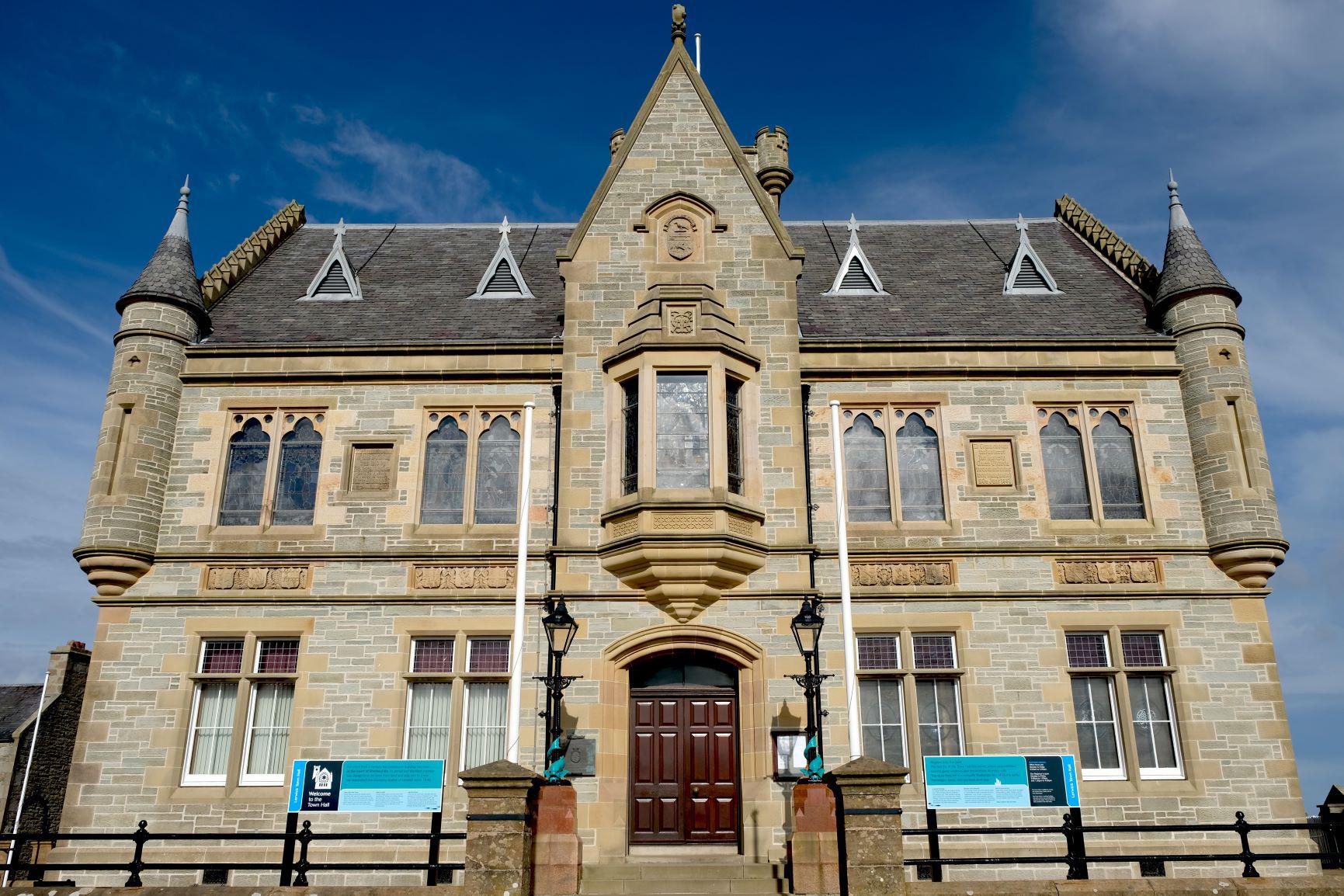
A brief introduction (excerpts taken from "Lerwick Town Hall - A Guide", written by Charlie Simpson)
Lerwick’s Town Hall is a nineteenth-century building incorporating a public hall. It was designed to dominate the surrounding townscape from its setting on the ridge of the Hillhead, intended to convey powerful images of Shetland’s heritage and Lerwick’s civic pride, and created to impress - both inside and out.
Since its opening in 1883 Lerwick Town Hall has served the town very well in its dual role as a prime venue for social or cultural events and a seat of local government; for Lerwick Town Council up to 1975, and Shetland Islands Council until March 2022, when Council meetings moved into a new chamber in the former St Ringans Church on the nearby Lower Hillhead.
Laying of the foundation stone
The formal laying of the Town Hall foundation stone was performed by Prince Alfred on 24 January 1882. Under the stone was placed a bottle containing a parchment with details of the ceremony and signatures of the Town Council and magistrates, along with copies of current newspapers and publications and a set of current coins of the realm.
On 30 July 1883, the building was opened formally by George Thoms, Sheriff of Caithness, Orkney and Shetland.
Originally no provision for stained glass
The original contract did not include everything in the completed building. In particular there was no provision for stained glass in the hall windows, or any other decoration.
A Decorations Committee was formed, the driving force behind which was Arthur Laurenson of Leog, a merchant prominent in Lerwick affairs and a keen student of Shetland history.
He also had the patience and ability to seek out decorative contributions of high quality from all over Europe, coaxing monarchs, civic governments, landed gentry and prominent citizens to supply the funds for stained glass windows, armorial tablets, fireplaces and paintings with which to grace the building.
When the Town Council took ownership
Lerwick Town Council made an offer to buy the Town Hall for £2750. The Directors accepted and the Council took ownership in November 1903.
In May 1975, reorganisation of local government in Scotland saw a single authority - Shetland Islands Council - formed to take the place of both Lerwick Town Council and Zetland County Council.
The Town Hall retained its status at the centre of local government after 1975, for it became, and still is, the headquarters of the new Islands Council in that the main meetings of the Council and its Committees take place there.
The old Burgh Courtroom is now the Council Chamber, while the old Town Council Chamber is now the Chief Executive’s general office and reception.
The offices where countless Lerwick tenants paid their rent and rates are now Ladies’ and gents’ cloakrooms and toilets.
"The Centenary of Lerwick Town Hall was celebrated in August 1983. For all that the centenarian looked well for its age, closer inspection revealed that all was not well outside."
In 1923 Thomas Manson wrote in his book 'Lerwick During the last Half-Century' "...here as an example is our Town Hall, only about 35 years old, and yet the stone facings, especially in the front, bear very unsightly evidence of being unable to withstand the wear and tear of our climate."
65 years after these words were written, the decay of the facing stones was much more advanced. The old Town Council had been aware of the problem; it was known that the facing stone was very porous and held water, which in strong wind conditions was virtually pumped into the building. Lack of resources prevented the Town Council for doing anything other than ‘first aid’ to the worst of the stonework and the most accessible leaks. The solution required complete replacement of the facing stone at enormous expense in both time and money, and fortunately, Shetland’s new Council had the resources and the will to undertake this task.
The building was regularly swathed in scaffolding
For more than a decade, one part or other of the building was regularly swathed in scaffolding for long periods and the hall closed, while specialist contractors removed more than 500 decayed Orkney stones and painstakingly rebuilt more durable facing stone from English quarries, including the complex oriel window in the main hall and its gable above, complete with replacement stone lion atop its peak.
Specialist contractors at work
As all the the stained glass windows had to be removed, each was dismantled, cleaned and releaded before reinstatement. During the project, the glass bottle placed under the foundation stone in 1883 was recovered; sadly water had penetrated, reducing its paper contents to a mouldy mush and leaving intact only the coins of the realm.
A replacement time capsule, of more durable material, was subsequently placed high in the oriel gable in January 1997, as the project neared completion. Along with current coins of the realm and a Town Hall guide book of 1984, it contains letters from the Council Convener, Chief Executive, staff involved in the restoration, school pupils, the stone supplier and the contractor, plus photographs and a selection of audio tapes and compact discs of speech and music.
Lerwick’s Town Hall continues to be a valued and versatile public asset, accommodating many public and private meetings, entertainments and functions including dinners, dances, weddings and civic receptions, along with fundraising events such as coffee mornings and exhibitions, while its fine acoustics are particularly suited to both instrumental and choral music recitals.