
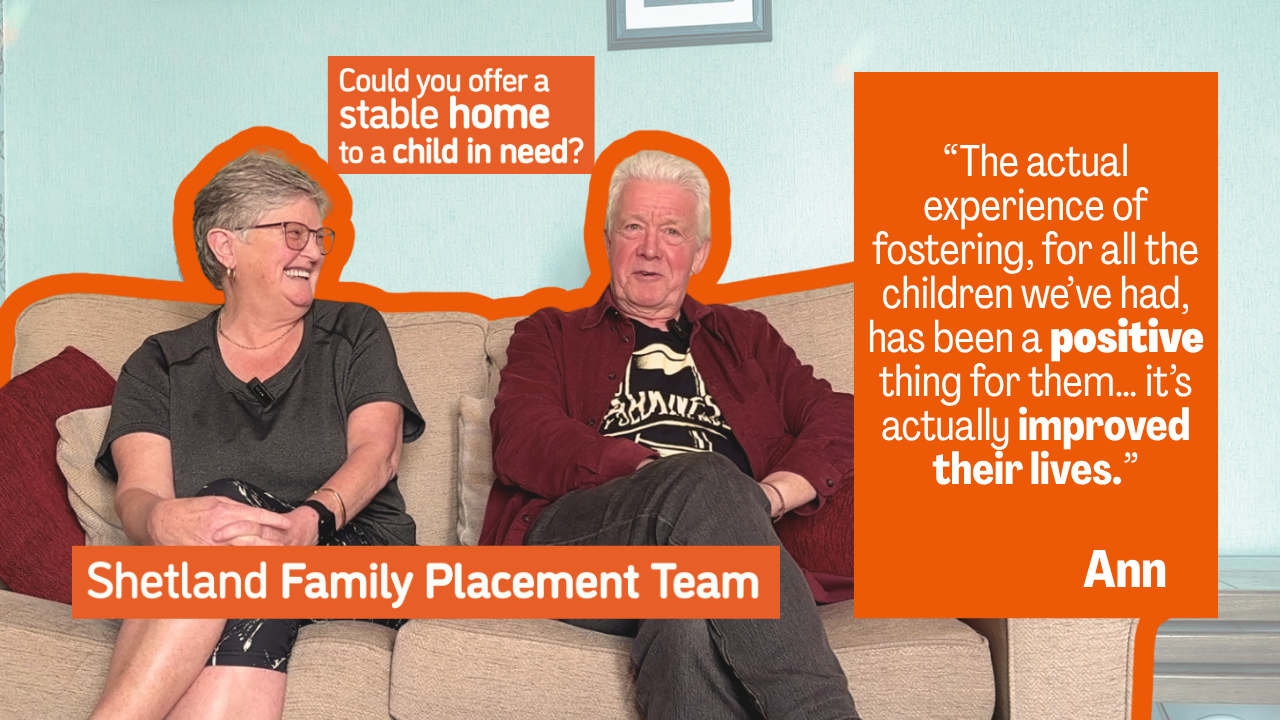
Recently retired Lerwick couple Ann and Ian share their experience as long‑time foster carers, offering stability, routine and care to children of all ages through short and longer‑term placements.
“We’d had three children and we seemed to do an okay job at bringing them up,” says Ann Thomson, when asked why she and her husband Ian first decided to become foster carers around 15 years ago.
It is an understated answer that probably goes some way to explaining why the Lerwick couple have proved so well‑suited to helping a succession of young people under their care over the past decade and a half.
Now recently retired, Ann and Ian clearly relish sharing their spacious old townhouse on Lerwick’s Hillhead, offering some much‑needed stability and family routine to young people ranging in age from toddlers to teens.
Ann says the initial idea was to offer short breaks and emergency fostering, but “it didn’t really pan out like that”. One wee boy came and ended up staying for 18 months, followed by two siblings whose six‑month placement “turned into three years” of full‑time care.
A girl who was entrusted to them for a couple of months in December 2019 ended up staying for the best part of two years due to the Covid‑19 lockdowns. “She still comes [to visit] – one of the benefits is we still keep in contact with a lot of bairns that have been here,” Ann says.
“I think it’s quite satisfying knowing that they still want to keep in contact with you, because with none of these bairns was it their fault that they ended up in care, and I would say we’ve provided lots of love.”
Ian says the couple, whose own children are all grown adults, would like to think there is “no child that’s come to stay with us who has come here and felt that they should be somewhere else”.
“In most cases you can almost [feel] a sense of relief that they’ve got somewhere where they can feel comfortable and protected, and they can learn to relax. So the actual experience of fostering, for all the children we’ve had, has been a positive thing for them… it’s actually improved their lives.”
On occasion they have chosen to take foster children on holiday to the Central Belt, and recently two siblings they were caring for enjoyed meeting up with Ann and Ian’s twin grandchildren, who they “just played away with the whole time, which is great”.
“I think we’ve learned quite a lot of skills because the bairns are all very different,” Ann reflects.
The most challenging placement (“the one that nearly broke us!”) was two young children from Orkney who had “never had any boundaries at all”. But by the end of their time with Ann and Ian they “ended up loving having a routine”.
“They were up at all hours of the night thinking it was morning! It was very much the case that we had to be joined at the hip and saying exactly the same things,” Ian says. “They were very good manipulators for young children, really!”
“When they went back,” Ann recalls, “I went with them and their social worker picked us up, and she couldn’t believe that they were the same children. They had totally changed in so many ways.”
Their approach is to be “an open book”, providing photographs of themselves and their house, along with some basic information, in advance so the children “know what they’re coming to”.
“It doesn’t take very long to establish a routine,” Ian says, “and once you have that routine, everything begins to fall into place. I never feel as though you have to make a special effort, you just be yourself, have some fun and games and laugh a lot, and the children soon respond to that.”
There is one house rule that they do insist upon: electronic devices must be left on a chair outside Ann and Ian’s room, irrespective of the child’s age, overnight.
“We are aware that they would be on it until all hours of the night, so not sleeping and not getting up,” Ann says. “That’s part of the information that they get before they come, and on the whole it’s never been an issue.”
Both of them describe the support of social workers in recent years as “faultless”, saying they keep in daily contact during placements. “We’ve had a few different social workers – Angela was our first one – and all of them have been excellent, couldn’t fault them at all.”
Flexibility and a willingness to say “no” are also a crucial part of successful fostering arrangements. Though retired for the most part now, for several years they fitted fostering around their own work and other life commitments.
Ann says they have enjoyed some success in encouraging others to become foster carers: “It’s not for everybody, I realise that, but anybody that wants a little bit more information about it, I’d be happy to provide it and encourage them to take the next step and follow through on their interest.”
She recommends that anyone considering fostering should “be able to cook okay, because food intake is such an important part of a child’s life”.
As any parent will know, a willingness to make changes to your own diet will also come in handy: “you might find yourself eating pizza every week”, Ian mock‑grumbles.
“You might have to make a few adjustments, but even with that you will find, as time goes on, that you have wee successes. The child that didn’t like that bit of broccoli or a wee drop of peas on their plate, suddenly it’s not so bad after all. It’s like having your own children – you just have to go with the flow.”
During an hour‑long conversation, the selfless focus is quite rightly on how fosterers can enhance children’s upbringing. But what do Ann and Ian get back themselves from fostering at a stage of life when many would be seizing a well‑earned opportunity to put their feet up?
“It makes us feel young,” beams Ian. “I mean, it keeps you on the go all the time, you’re not sitting around and staring at the television or something like that.”
Ann concurs: “When you’ve got a placement you’re very active, whatever age the person is, whether you’re running them here or there, or taking them swimming. I just love doing it.”
If you'd like to find out more about becoming a Foster Carer in Shetland, sign up to receive email updates from the Family Placement team or visit our fostering campaign page for more information