
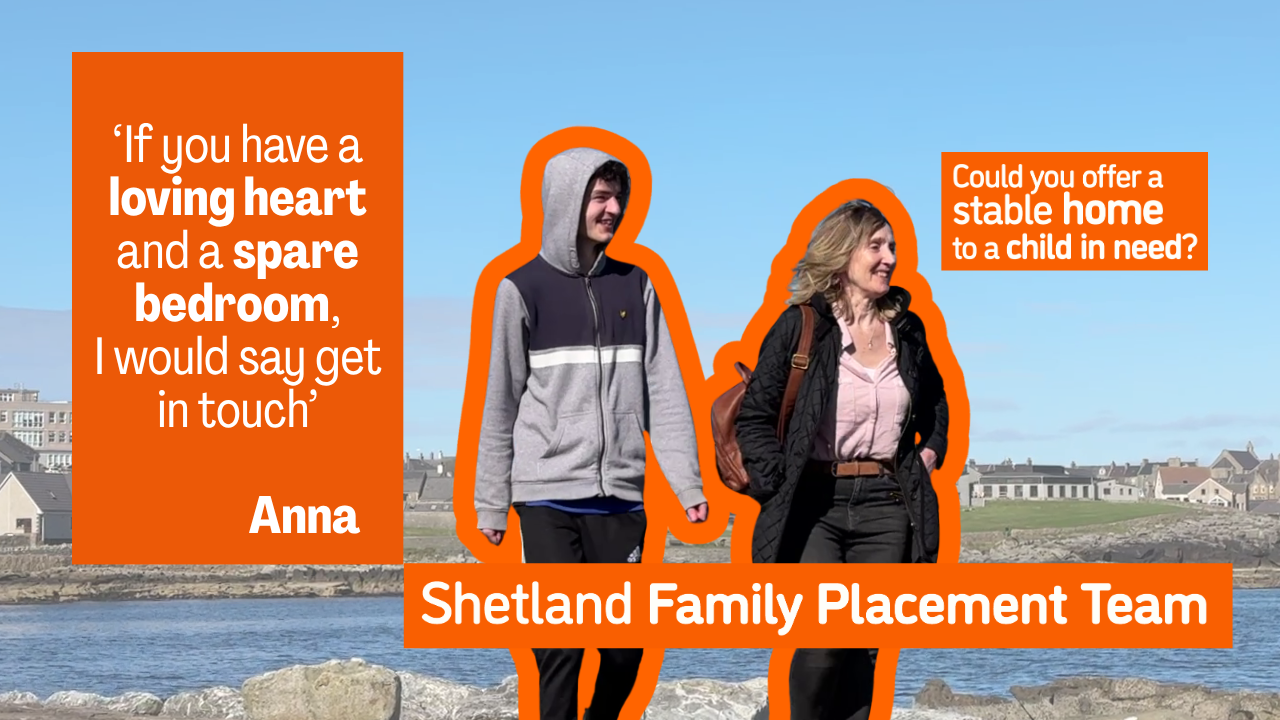
“If you have a loving heart and a spare bedroom, I would say get in touch with fostering – I’ve never looked back,” says Anna Forbes.
“There’s no obligation to carry on through the process, but just make a phone call, send an email – just see whether it’s something you’d want to go into.”
She is sitting on the sofa in her dining room alongside Sebastian, who she and her husband Mike first welcomed into their hillside home in Whiteness back in 2015 as a young boy navigating a troubled upbringing.
The pair clearly share a bond and a warm rapport that almost seems stronger than blood. It wasn’t always that way: having moved around a lot and never felt properly settled in his initial formative years, Sebastian (now in his late teens) was understandably reluctant to trust his newest carers.
“When I first met Sebastian he was an eight‑year‑old boy with a lot of different emotions, confused about where he was meant to be and how he was meant to act,” Anna says.
One crucial element of adapting to his new home was the fraternity he formed with the family’s golden labrador, Tess. Befriending the dog was a straightforward process for him as it removed the “trust issues” he faced in building relations with most humans, and “she just became my best friend”, he says.
Anna says she feels Tess, and now their fox red labrador, Millie, had a “real calming, therapeutic kind of influence on him, and she featured in so many things – all his drawings at primary school were of Tess, she went into the school for ‘show and tell’. So he got all these memories and established a sense of belonging, I suppose.”
The process of generating and embedding a trusting relationship began with Anna and Mike simply fulfilling Sebastian’s basic needs in terms of shelter, food and clothing. It then progressed into a pattern that came to feature play, bedtime stories and sharing various pastimes – as well as showing an interest in his hobbies.
“He always liked playing lots of video games, so I made myself go into his room and get him to show me games, and we’d play them. I was rubbish at them, but it was sort of a neat, cool place to be where we could chat and he could show me [his interests].”
Sebastian had initially only come to Anna and Mike for respite care, along with his older brother Jason, for a few months. But in autumn 2016, after their full‑time carers left Shetland, it was agreed they would stay longer‑term, before Jason eventually went back to living with their biological father.
“By that time we had actually started to establish a routine, and they got to know our family. Sebastian then got to benefit from more one‑on‑one care. It was hard work at times, but very, very rewarding.
“It was about having the patience and understanding and empathy, they weren’t just going to come and slot in and do everything you wanted them to do.”
Anna faced some difficulties growing up herself and, consequently, was very conscious not to do anything in her foster parenting that would “re‑traumatise” Sebastian.
“Mealtimes and bedtimes and all those things took a long time to establish. There was a lot going on as well, because they were having contact with some of the birth family, and that was quite unsettling for all parties.”
At first Anna would say “good night” and “I love you” and be met with curt responses like “good riddance” as she left the room. “I knew something had changed when, one night, I said ‘I love you’ and he went ‘okay’, and I knew he was beginning to accept that somebody cared for him.”
An intelligent and perceptive young man, Sebastian is clearly full of gratitude for the life he has been able to build with Anna and Mike’s help. Having finished school last year, he has been doing a placement with Bridges and hopes to move into the world of work shortly.
In 2024 they travelled to Norway to visit his birth mother, which Anna describes as a “really lovely experience” that helped Sebastian to “piece together the picture of what had happened beforehand”. They have done “life story work” to help fill in the gaps - “We’re really proud of where he is now”.
Sebastian is understandably eager for more people to come forward to become foster carers in the hope it will mean fewer children facing the “uncertainty” he did during his earliest years. “We need more people to do the job,” he says plainly.
Speaking about the process of becoming a foster carer, Anna recalls initially applying not long after moving to Shetland in 2002 as a single mum with four children. But she didn’t have enough room in her house at the time, and so the idea was shelved until she met Mike.
“I come from a big family, I’m the eldest of seven, and I didn’t have an easy childhood myself, so I have always wanted to help children who are in need of some kind.”
They began the process afresh, with her assessment taking “a little while because I’ve got quite a complex history myself”.
They were approved in 2015 and she speaks positively about an experience where she “learnt a lot about childhood trauma, which helped me”. She came to realise her own background was, in fact, more of a help than a hindrance.
Applying aspects of foster training such as the concept of “PACE” (playfulness, acceptance, curiosity and empathy) can really help.
“Having a sense of humour is really important, and not taking yourself too seriously,” Anna says. “Sebastian has a really dry sense of humour and I’m very laid back, so we can turn something that’s quite stressful into a bit of fun.”
She adds: “I never intended to be a foster carer for this long, but I’d never change it, and it really does change you for the better.
“You wouldn’t have to do it full time – there’s all different reasons why children come into care. It might be because the mum is in hospital and needs a weekend; it could be a regular respite thing.
“It’s just about having a loving, nurturing heart, and not having high expectations of the child at all, being adaptable and knowing that it will change your life forever, because you can’t try and fit them into your life.
“There’s a real need, and you’d be making a real difference to someone else’s life.”
If you'd like to find out more about becoming a Foster Carer in Shetland, sign up to receive email updates from the Family Placement team or visit our fostering campaign page for more information