
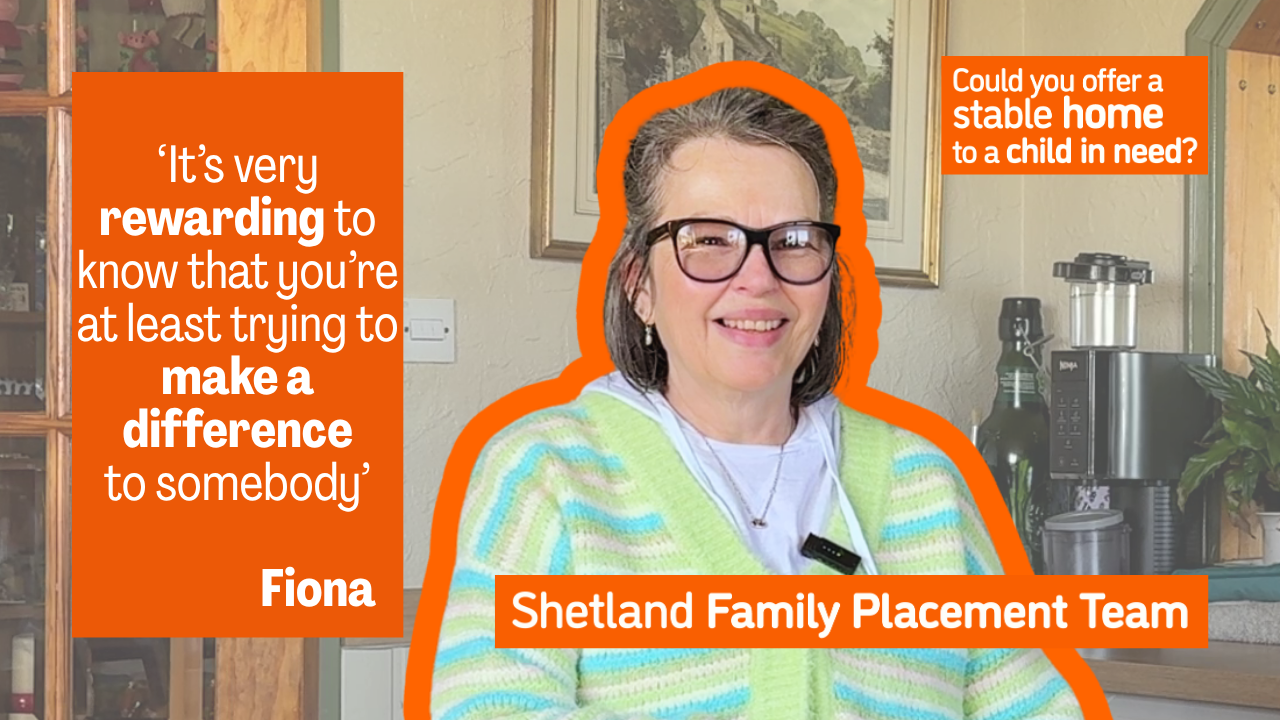
Living at the very end of Yell, Fiona shares how fostering has worked for her family, offering short‑term, respite and longer‑term care despite the challenges of remoteness.
When Fiona Taylor and her husband Michael first considered fostering, they weren’t sure what to expect. The couple sold their busy B&B business and relocated to Shetland around a decade ago, after Fiona’s own children had grown up and moved out.
“We had spoken about [it] in our previous location,” she explains, “but there wasn’t the need for what we could offer there.”
When the idea resurfaced, they wondered whether their new remote location “at the very, very end of Yell” would be suitable.
“We thought we wouldn’t get anything, to be honest,” Fiona laughs. “Some of the children don’t want to be this far away for a long period, so we assumed it wouldn’t happen.”
But that didn’t deter them. With a spare bedroom and a household full of animals (including two dogs and a pair of turkeys), they decided to give fostering a try.
“We thought we wouldn’t get anything, to be honest, because we’re so remote.”
The couple initially hosted a number of short‑term and respite placements, including some holiday cover for other foster carers in Yell.
They also took on a couple of shorter placements where it was felt their location might benefit the young person by enabling them to “get away from it all” for a spell. Their current placement, a 16‑year‑old girl, has been with them for almost a year.
“[With] the short‑term stuff, you’re just trying to make something as nice as you possibly can for a few days,” Fiona says. “With the long‑term stuff, you have to actually parent. You make sure they’re doing things that are good for them, even if it’s not always what they want.
“You just get to know them so much better and understand a little bit more of what’s going on, and what they’re feeling and thinking.”
She continues: “You do have to be prepared for hard things. It’s not all ‘let’s make it lovely for them and they’ll be happy’. Caring means not allowing them to do things that are stupid… even though they think that’s a good idea.”
Her own children, now in their thirties, have been very supportive. While there hasn’t been space for visits over the past year (“Brighton is a very long way away”), her middle child lives just down the road and regularly comes to spend time with their current foster placement.
They’ve even taken her to Aberdeen to meet their son and daughter‑in‑law, helping her feel connected to the wider family.
“The house is really the same,” Fiona reflects. “We haven’t had to change much. There is a spare bedroom, with a bed that never really got used, and the animals are all still here.”
She also notes that their pets, which might have seemed a barrier to fostering, have actually helped their current placement settle in: “She and the dog will lie on the floor and roll around together!”
Prior to fostering, the couple worked in various roles, including running a B&B with holiday cottages. Michael now works in the kitchen at Baltasound School: “He loves the kids and he loves feeding the kids. He does all the fun stuff – and everybody loves him,” Fiona says fondly.
Before having her own children, Fiona worked as a nurse, first in adult nursing and later in paediatrics, and since moving to Yell has variously found employment in a care home, as care support in the community, and in learning support at the local school.
While their professional backgrounds have provided valuable experience to take into foster caring, it was their personal backgrounds that served as the driving force to make the step, and which Fiona credits with making them successful in what they do.
“It was really Michael who wanted to do it,” she explains. “I had had my three children, so I didn’t feel the need desperately.
“He’d had a very unpleasant childhood and unfortunate things happened, so he wanted to see if he could make things better for children who are having a horrible time. I’d had a lovely childhood myself, with lovely experiences, which kind of works, because we both understand the different points of view.”
Fiona describes the process of applying to foster as thorough but reassuring. “It’s quite intrusive – they want to know everything about your life – but it’s worth it,” she says.
She encourages anyone considering fostering to be honest from the start. There were some elements, particularly in relation to Michael’s troubled start in life, that made them concerned they might be deemed unsuitable.
“If there’s something in your past that you think might be a barrier, just bring it up,” Fiona says. “There are lots of things you might worry about that actually won’t stop you.”
“You hope. I don’t know if you can know if you’ve done the right thing until maybe something happens later in life and they realise that it was good for them.”
Reflecting on her personal experience of fostering, she is quietly philosophical. “It is very rewarding when you see them happy, and you see that they’re settled in and you have done something worthwhile.
“You hope. I don’t know if you can know if you’ve done the right thing until maybe something happens later in life and they realise that it was good for them.”
Her final message for anyone considering fostering is to “go for it”.
“It’s a big process to actually get there, and there’s plenty of points where you can change your mind if you think it’s not for you, but it’s worth it to find out all the details.”
She adds: “Ultimately, it’s very rewarding to know that you’re at least trying to make a difference to somebody.”
If you'd like to find out more about becoming a Foster Carer in Shetland, sign up to receive email updates from the Family Placement team or visit our fostering campaign page for more information